
Laterite, lime, country wood — a material register for Malabar
What we specify on most of our houses, why, and what we have stopped specifying. A working register of materials that hold their character in the Calicut climate.
By Ar. Varun Gopal · Co-founder & Principal Architect
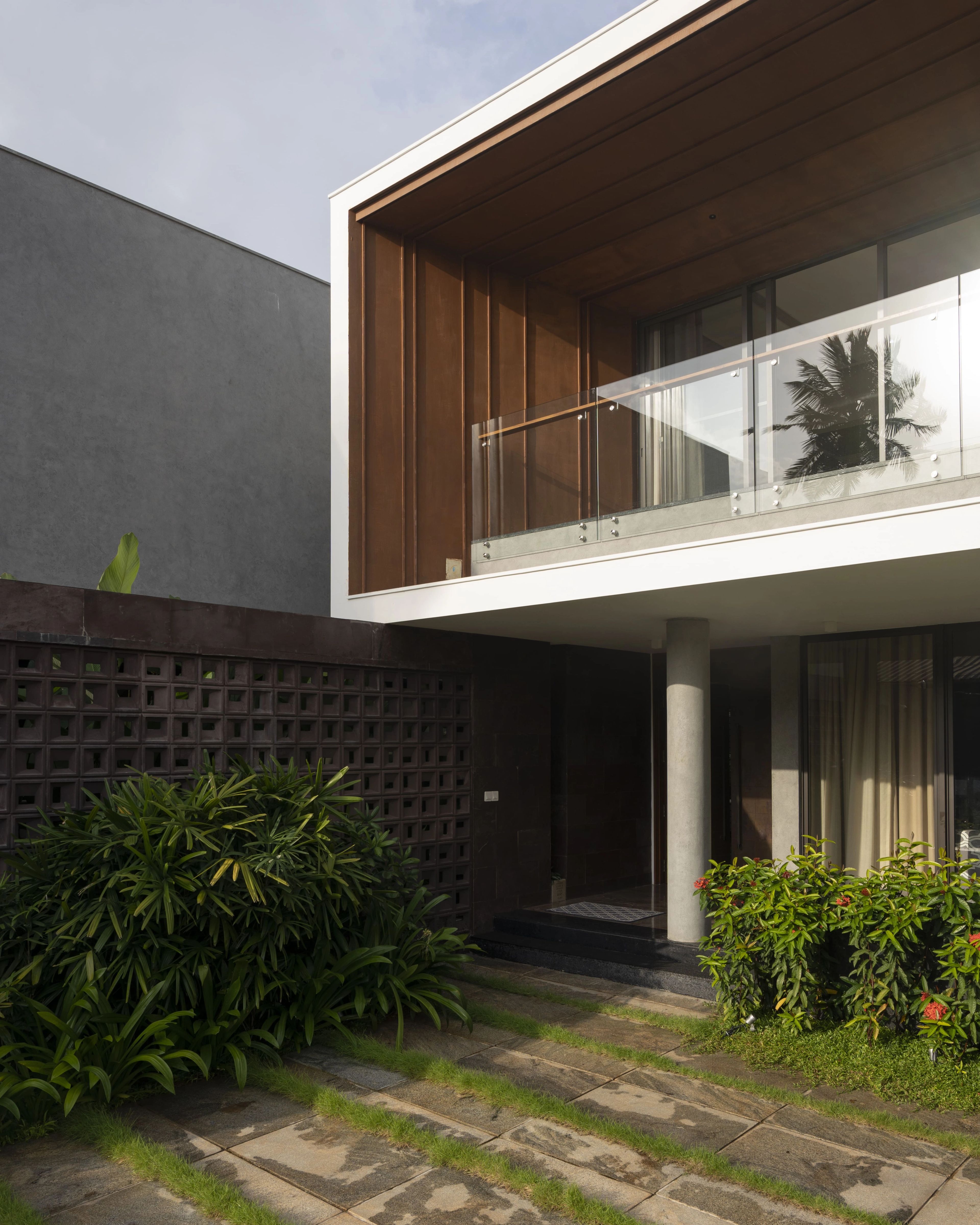
Every studio has materials it returns to. Not because they are fashionable, and not because they are local for local's sake — but because they earn their place over a decade, in a climate, across a portfolio. Here is the working register for ours, written as honestly as we can — what we use, what we've moved away from, and what we have not figured out yet.
Walls
Laterite
Our default. Quarried in Malabar, cut to block, and laid wet. It carries the colour of the ground it came from. Used exposed, it weathers to a warm rust that gets better with age. Used plastered, it gives the wall mass and breath.
Caveats: not all laterite is the same. The good stuff is dense and honey-coloured; the bad stuff is porous and fades to grey. Always specify the quarry. Always reject blocks that won't hold a clean edge.
Brick
Where laterite is too expensive or the wall is internal, we use a good wirecut brick. Stable, dimensionally accurate, plasters cleanly. Not as expressive as laterite when exposed — we mostly use it covered.
Concrete block — only where we must
Hollow blocks went into the early projects because they were cheap and fast. They also crack at corners, transmit sound, and feel like concrete blocks. We mostly don't draw them anymore. Where they're unavoidable, we plaster heavily and accept the structural compromise.
Floors
Oxide
Red oxide, grey oxide, occasionally black. A pigmented cement floor that polishes to a soft sheen and ages beautifully. Specify the recipe by weight, not by eye — a 4 percent oxide load reads very different from a 6 percent load. Always test a panel on site before pouring the whole floor.
Caveats: oxide floors need waterproofing under wet areas and patience during cure. They will hairline over two or three years. We tell clients in advance — hairlines are the floor settling in, not failing.
Country tile (Athangudi)
Hand-set tile floors with strong geometric patterns. Better suited to specific rooms — entry halls, pooja rooms, occasional accent spaces — than whole houses. The pattern reads quickly; too much of it overwhelms.
Indian stone — granite, kota, sandstone
Where we want a harder, cooler floor. Local kota in the rain-prone areas works well. Sandstone is for verandahs and outdoor spaces. Granite is restrained — flamed finish, not polished, kept to grey or charcoal.
Vitrified tile
Useful where the room sees heavy wet — bathrooms, utility, sometimes a kitchen. We mostly stay in the 60 by 60 cm range and pick a matt finish. Glossy tile is a maintenance promise we do not want to make.
Wood
Country woods — teak, jackwood, anjili
The honest woods of Kerala. Teak is the workhorse — heavy, stable, weather-tolerant, expensive. Anjili (jackfruit-tree wood) is the underrated alternative — beautiful golden colour, takes a polish, hardens with age. Jackwood is the same family, slightly less stable.
Caveat: country wood has to be properly seasoned, which most yards do badly. We buy seasoned timber direct from sawmills, store it on site for a month before joinery, and treat termite-prone areas separately. The price difference between raw and seasoned timber is small. The reliability difference is enormous.
Plywood
Boiling water-proof (BWP) only. Anywhere damp, anywhere joinery has to last. The marine-ply premium is worth paying every time. Cheap commercial ply delaminates in the monsoon — you'll see it bubble within two years.
Plaster and finish
Lime plaster
Our preferred external finish. Breathes, lets the wall dry out after rain, ages with grace. Two coats over a properly prepared base. Less crack-prone than cement plaster, far more forgiving to look at.
Caveat: lime plaster needs a mason who understands lime plaster. The trade is shrinking. We have two crews we trust; if neither is free, we adjust the schedule rather than substitute.
Internal — IOP / IPS
Internal surfaces are often Indian-oxide paint over plaster, or polished cement (IPS) on accent walls. Both are quiet and warm. We avoid most acrylic paints.
Metals
Brass for door hardware where the budget allows. Stainless steel everywhere else — the climate eats mild steel. Powder-coat or galvanised finishes on rebar exposed to rain. Aluminium for window frames only where teak doesn't make sense; we still prefer teak.
Roofs and ceilings
Clay tile on a wooden frame, traditional Mangalore tile or local pattern. RCC slabs where the geometry needs them, finished in a brushed concrete or skim coat — not painted. Ceilings are often left as the underside of the slab; occasionally we drop a wood-batten ceiling for warmth.
What we no longer specify
POP cornicing. Gypsum board in any wet zone. Cheap acrylic emulsion. MDF anywhere unless internal joinery in a fully dry room. Pre-laminated composite panels. Powder-coated MDF panels. We have used some of these and watched them fail; the register gets shorter with experience.
How we choose
The simplest test: would this material be honest about its age in twenty years? If yes, it stays. If no, it doesn't. The houses we are proudest of are the ones whose materials have a story by the time anyone visits them — laterite that has warmed, wood that has darkened, lime that has settled. If you would like to walk through a few finished examples, the projects page is the best place to start.